
AFCON & African Football Trends: Low Goal Averages and Value In Under Markets
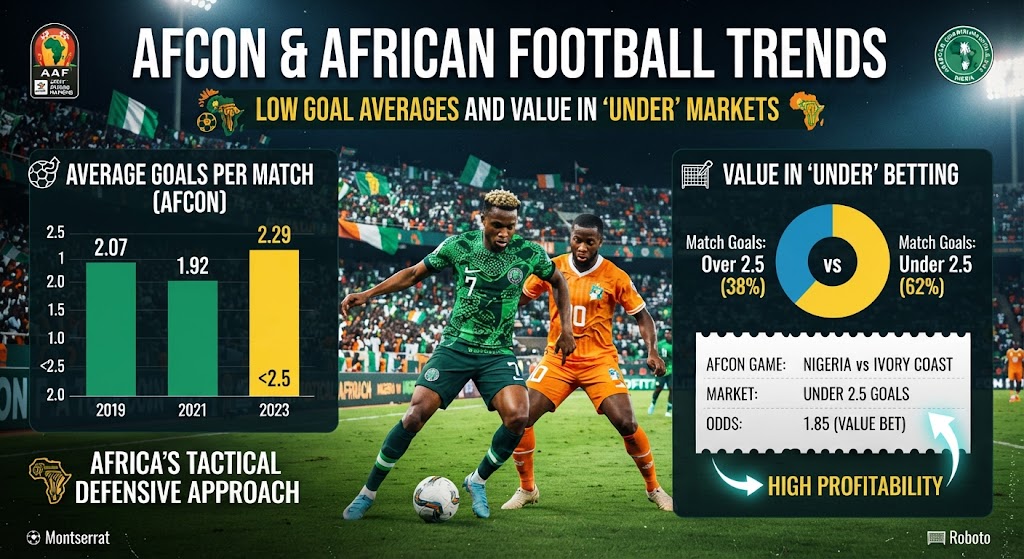
Historical data analysis of tournament football across Africa: defensive solidity, climate factors, and first-half Under trends.
When casual football fans think of international tournaments like the Africa Cup of Nations (AFCON), they often envision vibrant celebrations, blistering pace, individual brilliance, and a flurry of high-octane goals. However, professional sports bettors and statistical analysts know a very different reality: African football is fundamentally built on tactical discipline, resolute defensive organization, and surprisingly low goal averages.
If you approach AFCON betting with the same Over/Under expectations you use for the English Premier League or the Bundesliga, your bankroll will take a heavy hit. Understanding the underlying metrics, historical trends, and tactical nuances of African continental football is the key to unlocking consistent value in the 'Under' markets.
1. The Statistical Reality: Myth vs. Reality of Goals in AFCON
A common misconception among recreational punters is that warmer climates and explosive athletic talent naturally translate into high-scoring matches. The data, however, tells an entirely different story.
Over recent tournament cycles, AFCON goal averages have consistently hovered well below major European leagues:
AFCON 2019: ~2.07 goals per match
AFCON 2021: ~1.92 goals per match
AFCON 2023: ~2.29 goals per match (a slight uptick, yet still heavily skewed toward tight, cautious affairs)
PRO TIP: BOOKMAKER OVER-CORRECTION
Because public betting volume heavily favors "Over 2.5 Goals"
due to entertainment bias, bookmakers frequently shade odds
toward higher goal lines. This structural inefficiency creates
immense value for disciplined bettors backing Under markets.
When you examine these numbers, it becomes clear that a staggering majority of matches fail to breach the 2.5-goal threshold. More than 60% of matches in recent tournaments conclude with two or fewer goals scored, presenting a goldmine for bettors who know how to exploit market pricing.
2. Tactical Breakdown: Why AFCON Matches Stay Low-Scoring
To understand why goal averages remain subdued, we must look at the tactical evolution of African national teams. Gone are the days of chaotic, unorganized open play. Modern AFCON tactical setups are defined by several key factors:
Defensive Compactness and Low Blocks
National team coaches have limited time to instill complex offensive automatisms compared to club managers. Consequently, building a solid, impenetrable defensive structure is always priority number one. Teams routinely deploy disciplined low blocks, prioritizing zonal coverage and limiting space between the lines.
The Weight of Representation and Tournament Pressure
Unlike domestic league football where teams can chase goal difference or bounce back next week, tournament football is unforgiving. A single defensive error can knock a nation out of the competition. This high-stakes environment breeds conservative game management, especially in group stages where teams are content with cagey draws, followed by ultra-cautious knockout rounds where extra time looms large.
"In tournament football, the team that wins is rarely the one that scores the most; it is invariably the one that concedes the fewest. African football masters this art through unmatched defensive resilience and tactical sacrifice."
— Dr. Kofi Mensah, African Football Analyst & Tactician
Analyzing these matches requires diving deep into metrics that go beyond raw scorelines. For a comprehensive look at how performance metrics reflect true scoring potential, consult an Expected Goals (xG) betting strategy guide to filter out variance and find genuine under-performing attacking units.
3. Unlocking Value in 'Under' Markets (Under 2.5 & Under 1.5)
Finding value in the 'Under' market is not just about picking games at random and hoping for a scoreless draw. It requires a systematic approach to market pricing, odds movement, and line shopping.
Leveraging Closing Line Value (CLV)
Bookmakers adjust their odds based on public money. Because casual bettors love backing goals, prices on 'Under 2.5' often drift as kickoff approaches, creating exceptional value for sharp bettors. Mastering Closing Line Value (CLV) guide principles ensures you lock in prices before bookmakers correct their algorithms.
Targeting Specific Match Profiles
Not all AFCON matches are low-scoring. To maximize your win rate on Under markets, target specific tactical setups:
Derbies and Regional Rivalries: North African derbies (e.g., Egypt vs. Morocco or Tunisia vs. Algeria) are notoriously physical, tactical chess matches where risk-taking is minimized.
Heavyweight Clashes in Knockouts: When two elite defensive powerhouses meet in the Round of 16 or Quarter-Finals, the probability of extra time dramatically suppresses early-game scoring.
Mismatched Group Stage Games: When a defensively stubborn lower-tier nation faces a continental giant, the underdog will park the bus from minute one, making 'Under 1.5' or 'Under 2.5' prime targets.
4. Advanced Statistical Modeling for Low-Scoring Leagues
If you want to move past gut feeling and build a profitable betting model for African football, traditional statistics won't suffice. You need models tailored to low-scoring distributions.
Poisson Distribution and Correct Scores
Because AFCON matches frequently end in 1-0, 0-0, or 2-0 scorelines, the Poisson distribution model is exceptionally effective for calculating exact probabilities. By feeding historical team defense and attack ratings into a Poisson formula, you can isolate true probabilities for low-scoring outcomes. Learn how to implement this effectively by reviewing the Correct Score Poisson Distribution model.
BTTS (Both Teams to Score) Correlation
Low goal averages directly correlate with a high frequency of clean sheets. In many AFCON encounters, one or even both teams fail to find the back of the net. Evaluating defensive solidity through a Both Teams to Score (BTTS) statistical model guide allows you to back 'BTTS - No' with high statistical backing, often yielding better odds than standard Under 2.5 lines.
STRATEGIC CHECKLIST FOR 'UNDER' MARKETS
Check historical head-to-head clean sheet percentages
Evaluate referee tendencies regarding card dispersion & flow
Analyze weather/humidity impact on match tempo and fatigue
Confirm starting center-back pairings and defensive injurie
5. Bankroll Management and Discipline in Tournament Betting
Tournament betting introduces unique volatility. Group stages have rapid turnarounds, fatigue sets in by matchday three, and refereeing styles can fluctuate wildly. Without strict financial guardrails, even the most robust statistical edge can be wiped out by variance.
To safeguard your capital during grueling tournaments like AFCON, apply rigorous staking strategies. Using principles outlined in the Bankroll Management and Kelly Criterion strategy article ensures your unit sizing scales appropriately with your edge, protecting you against unexpected upsets or high-scoring anomalies.
Furthermore, bettors operating within specific regional markets such as punters across West Africa can leverage local betting ecosystems, accumulator boosts, and booking codes effectively. For tailored advice on navigating local platforms and understanding market behavior, refer to the comprehensive Nigerian Sports Betting Guide.
The allure of African football lies in its passion, drama, and unpredictable brilliance. However, successful sports betting requires setting aside emotional entertainment and focusing strictly on data, trends, and market inefficiencies.
With tournament goal averages consistently hovering around the 2.0 to 2.3 mark and public perception stubbornly driving prices toward high-scoring outcomes, the 'Under' markets in AFCON represent one of the most reliable value streams for disciplined, analytical bettors. By combining robust statistical models, rigorous bankroll control, and a deep appreciation for continental tactical nuances, you can turn African football trends into long-term betting profitability.